Humans are natural any-horizon reasoners—we can iteratively skim long videos or watch short ones in full when necessary. Yet, most SOTA models follow the DIRECT paradigm, processing entire long videos in a single turn, which is resource-heavy and inefficient.
To move toward the AGENT paradigm, we explore the following question:
"What are the technical challenges toward effectively training video reasoning models under the AGENT paradigm with Reinforcement Learning?"
We identify three significant aspects required to answer this:
System Design: Existing agents often rely solely on temporal grounding, which can be ineffective for long videos.
Solution:SAGE, a system equipped with tools like Web Search and Speech Transcription to leverage non-visual signals.
Data: Training long-video agents requires high-quality QnA pairs. Human annotation is expensive for long videos.
Solution: A cost-effective synthetic pipeline using Gemini-2.5-Flash.
RL Optimization: The variable duration of videos makes training "any-horizon" behavior difficult. Standard RL recipes (e.g., for math) often lack verifiable rewards for open-ended video tasks.
Solution: A multi-reward RL recipe using a strong reasoning LLM as a judge to handle open-ended video tasks resembling real-world entertainment use cases.
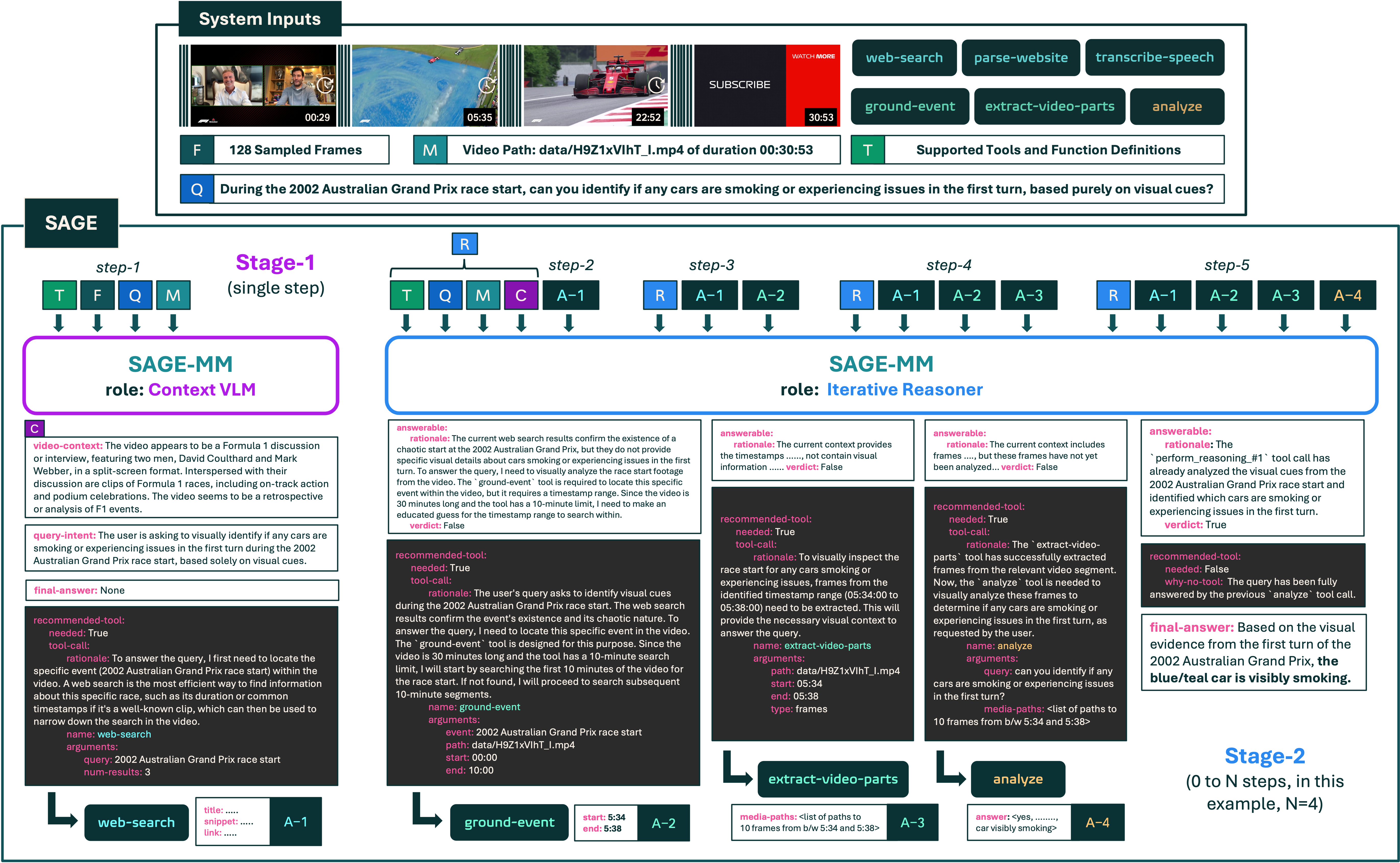
SAGE operates in two stages based on the role of the orchestrator (SAGE-MM):
Stage-1 (Context VLM): In this single-step stage, SAGE-MM accepts system inputs (tools, sampled frames, query, metadata) and provides information about the video's context along with either a final answer prediction or a tool call to be executed before the next step.
Stage-2 (Iterative Reasoner): In this multi-step stage, SAGE-MM uses the video context and tool call results from previous steps to decide either to predict the final answer or call another tool in an iterative reasoning process.
Supported Tools
Tool Name
Purpose
Arguments
Returns
web-search
Perform web search using a text query.
query (str); num-results (int)
List of URL, title, and snippet for search results.
parse-website
Parse web data from a given URL.
website-url (str)
Parsed HTML content of the website.
transcribe-speech
Perform ASR on the video.
path (str), start (str), end (str)
Segment-level verbal transcript between start and end timestamps.
ground-event
Identify timestamps for an event in the video.
event (str), path (str), start (str), end (str)
Timestamps for the event between the start and end timestamps.
extract-video-parts
Extract frames or subclips between two timestamps.
type (str), path (str), start (str), end (str)
List of paths to the saved extracted parts (frames or subclip).
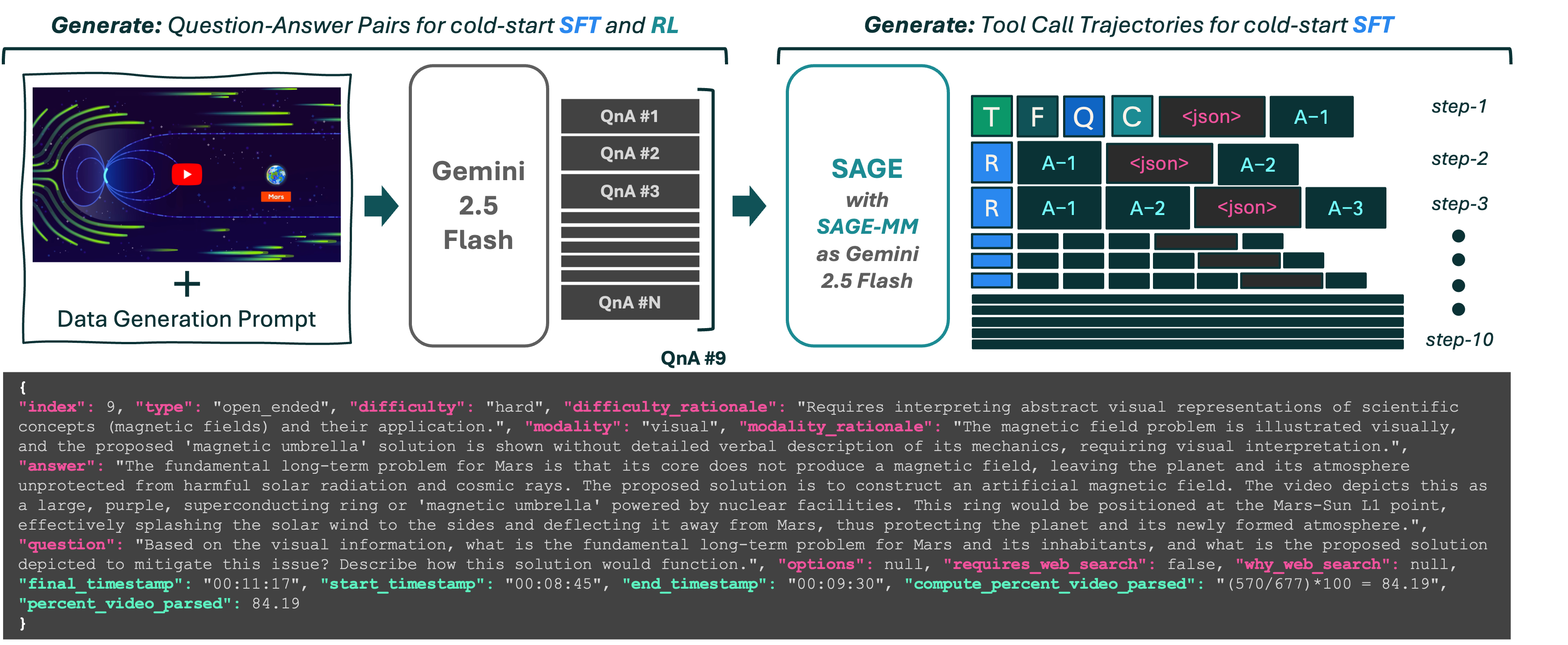
We introduce an easy synthetic data generation pipeline using Gemini-2.5-Flash to train the orchestrator.
QnA Pairs: We leverage the long-context modeling abilities of Gemini-2.5-Flash to generate high-quality QnA pairs covering the entire video.
Tool Call Trajectories: We use a SAGE system with Gemini-2.5-Flash as the orchestrator to synthesize tool call trajectories for a cold-start SFT stage.
To instill any-horizon reasoning, we employ Group Relative Policy Optimization (GRPO) for trajectory-level optimization. We utilize a multi-reward recipe that combines intermediate reward components with a final accuracy reward.
Reward Function
Format
Enforces correct JSON syntax.
Reasonable Tool
Uses GPT-4o to judge if tool usage is rational.
Argument Checks
Penalizes repetitive or invalid arguments.
Accuracy
Final LLM-as-a-Judge verdict on the answer.
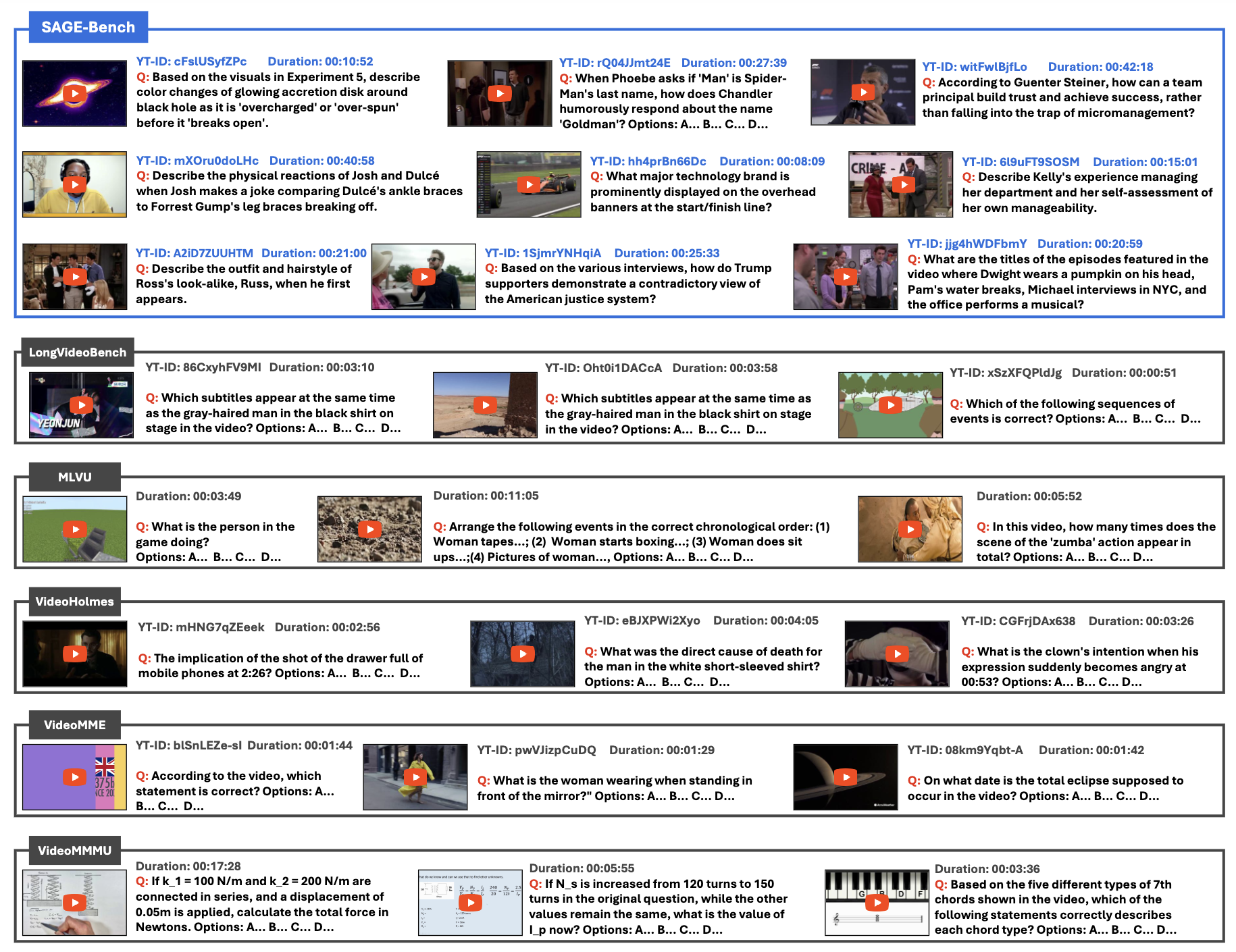
SAGE-Bench focuses on open-ended, real-world entertainment scenarios unlike previous benchmarks that rely heavily on multiple-choice questions.
Driven by the limitations of current video reasoning benchmarks (primarily their focus on Multiple Choice Questions), we curated SAGE-Bench. This evaluation set consists of 1,744 manually verified samples with an average video duration of over 700 seconds.
Key Features:
Source: Videos from 13 popular YouTube channels covering diverse genres including Sports, Food, Comedy, Education, and Travel.
Open-Ended Focus: SAGE-Bench utilizes open-ended questions with an unbounded answer space, better simulating real-world user interactions.
Diagnostic & Practical: Includes both diagnostic questions to test fundamental capabilities and practical questions that a user might naturally ask.
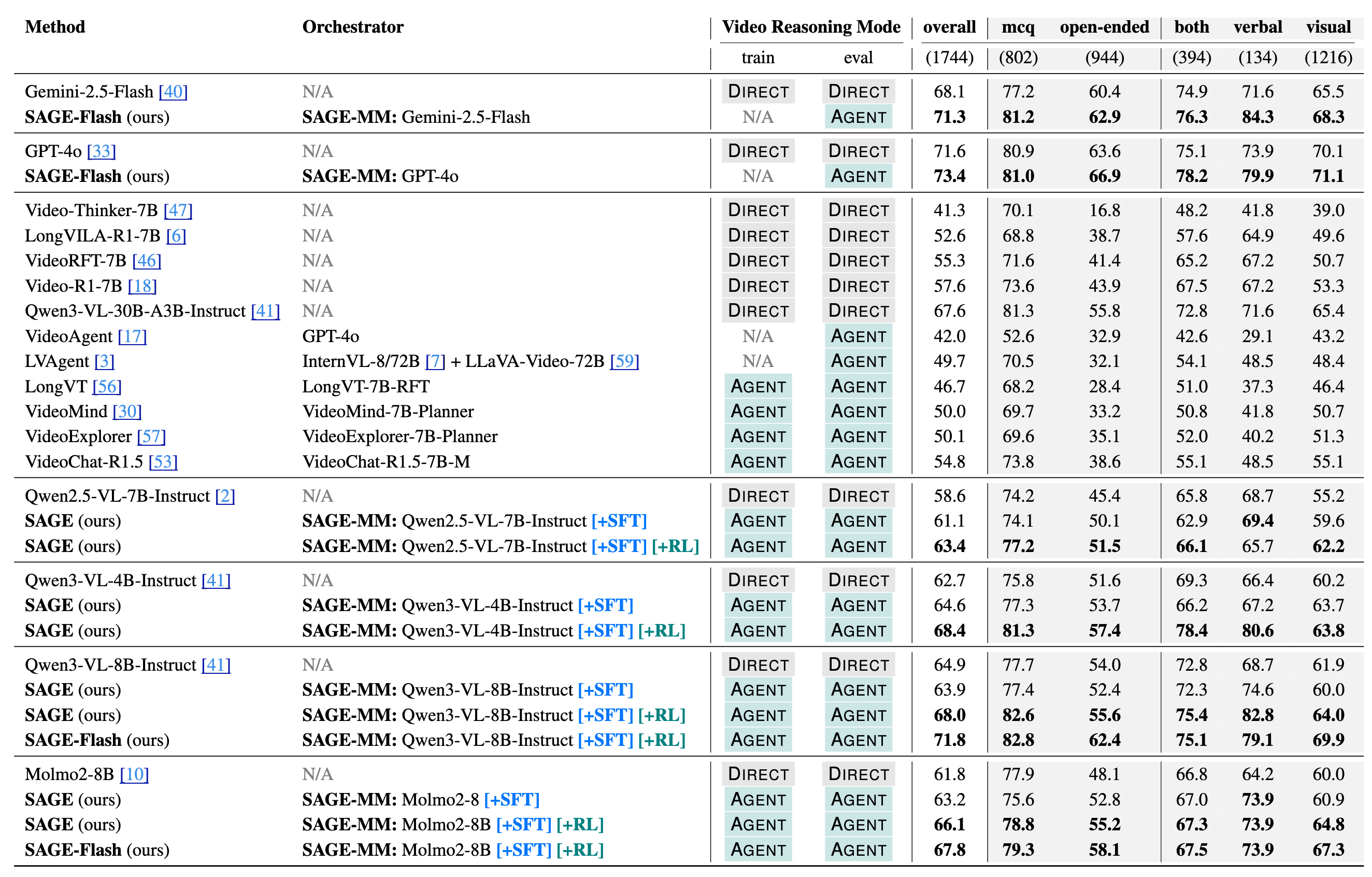
We empirically validate the effectiveness of our system, comparing it against both DIRECT and AGENT baselines.
Key Findings:
Overall Performance: SAGE achieves improvements of up to 6.1% on open-ended video reasoning tasks compared to base models.
Long Video Reasoning: On videos longer than 10 minutes, SAGE shows an impressive 8.2% improvement.
Effect of Tools: Incorporating Gemini-2.5-Flash as a tool (SAGE-Flash) further boosts gains to 14.6% on long videos, highlighting the system's ability to leverage stronger backend tools.
Duration-wise Turns
SAGE demonstrates "any-horizon" behavior by adapting the number of reasoning turns to the video duration. The average number of reasoning turns gradually increases from ~1.7 for short videos (<60s) to ~2.9 for long videos (>1200s), indicating that the model learns to call more tools when faced with longer, more complex content.
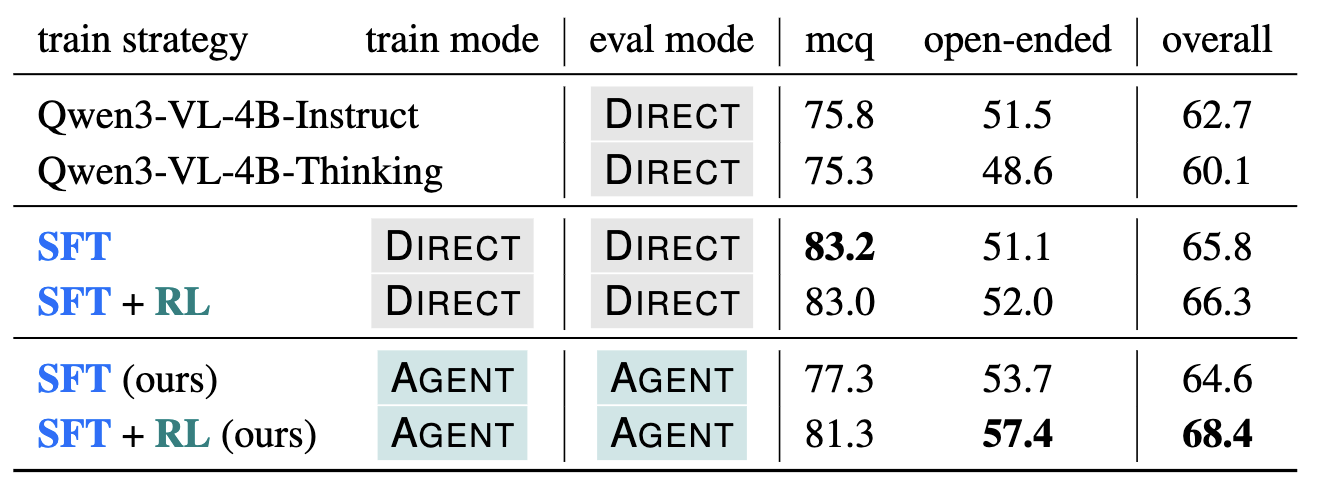
Comparison to data-matched DIRECT baseline
Our AGENT training recipe consistently outperforms the DIRECT baseline. The RL post-training specifically improves the open-ended reasoning capabilities.
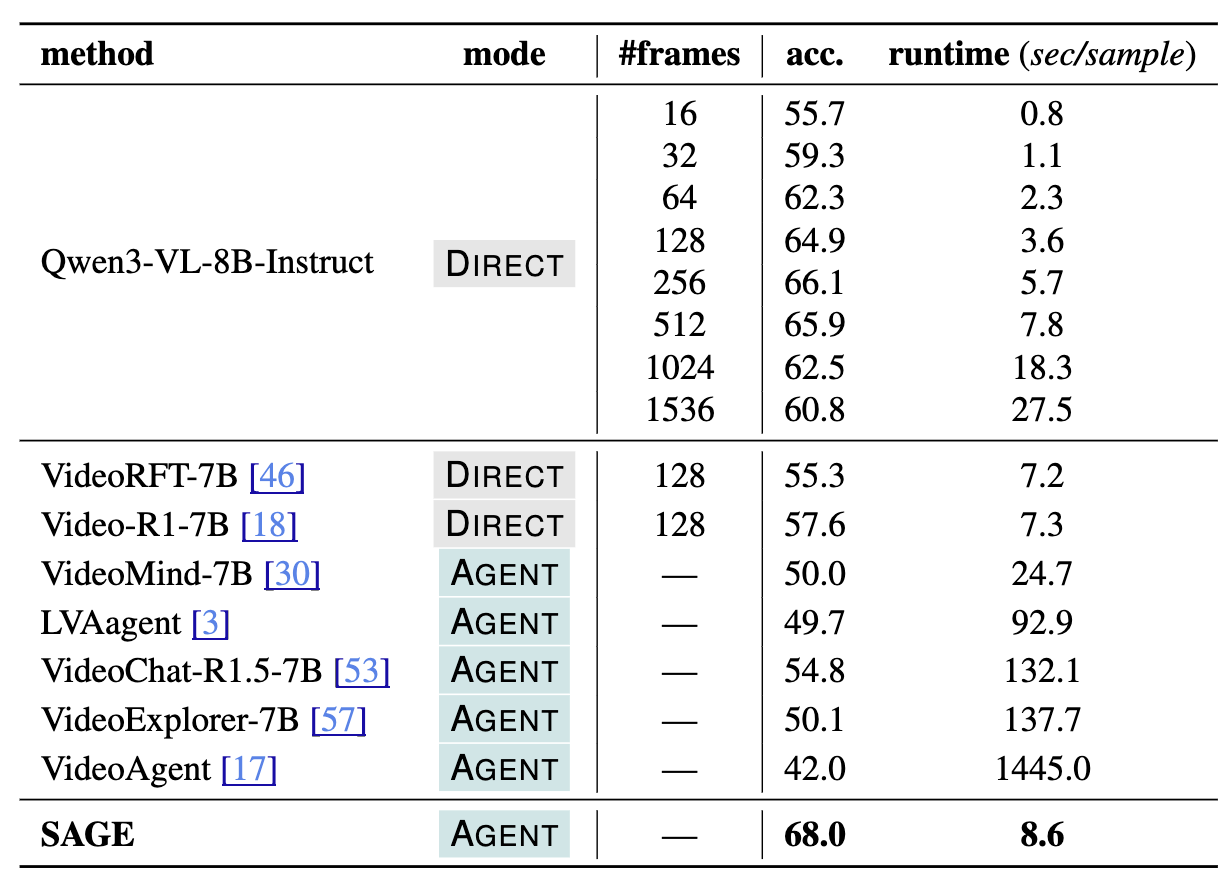
Runtime Efficiency
SAGE is highly efficient compared to existing agent systems, processing samples at approximately 8.6 seconds/sample.
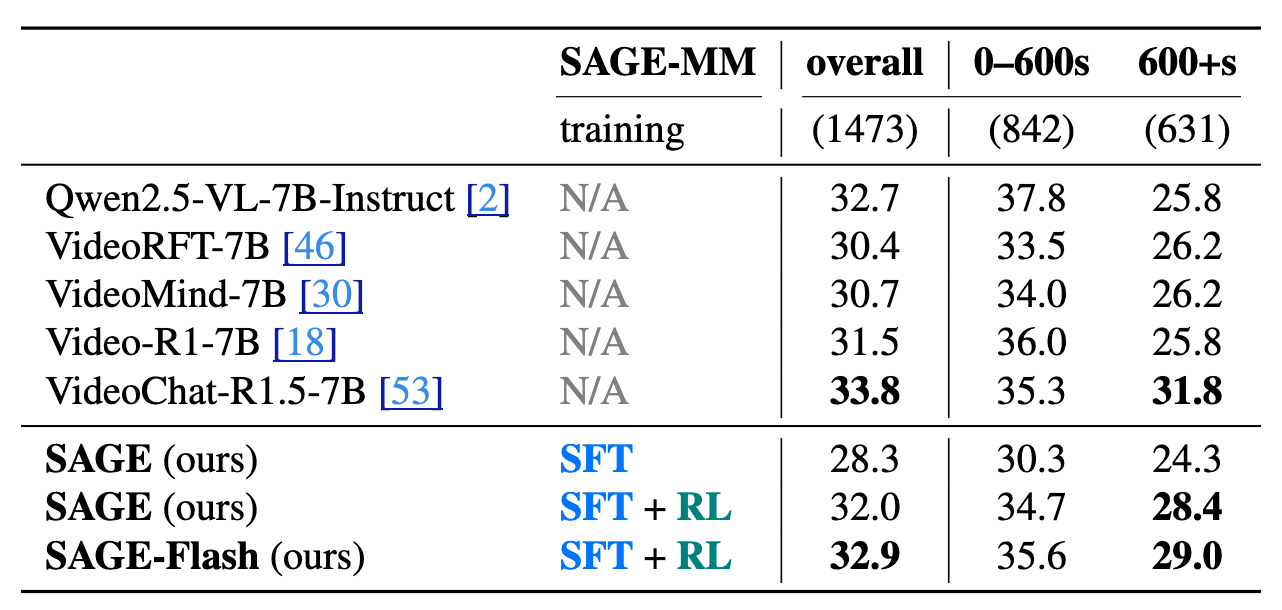
Results on MINERVA Benchmark
MINERVA is a complex video reasoning benchmark covering domains such as sports, short films, and cooking videos. SAGE shows significant improvements on videos longer than 600 seconds.
Reward Plots during RL
Smoothed reward curves for the SAGE-MM-Qwen3-VL-8B-SFT_RL model. Reward and penalty definitions are shown under each curve; trajectory length is included as a rollout diagnostic.
Total reward and accuracy reward trend upward through RL, indicating improved task-level behavior.
Format reward stabilizes after early training, showing the policy learns the required response structure.
The scalar trajectory reward combines the per-action reward components with the final answer reward, then is assigned to every action in the trajectory.
Accuracy reward
Final accuracy reward \(a_N\)
-2.0
JSON action string is invalid
-0.5
Wrong final answer and \(N \ge 1\)
+1.25
Correct final answer with visual tools in \(\tau_i\)
+1.0
Otherwise correct final answer
Computed at the final step using the GPT-4o LLM judge verdict.
Format reward
Format reward \(s_{\mathrm{format}}\)
+0.05
JSON contains only the required fields
-0.10
Otherwise
Encourages the action string to follow the required JSON schema.
This plot tracks the number of steps in the rollout. The paper uses \(N_{\max}=11\) by default, with \(N_{\max}=6\) for the first 100 RL steps for stability.
@inproceedings{jain2026sage,
title={{SAGE: Training Smart Any-Horizon Agents for Long Video Reasoning with Reinforcement Learning}},
author={Jain, Jitesh and Li, Jialuo and Ma, Zixian and Zhang, Jieyu and Kim, Chris Dongjoo and Lee, Sangho and Tripathi, Rohun and Gupta, Tanmay and Clark, Christopher and Shi, Humphrey},
journal={CVPR},
year={2026}
}